No. Intensive driving courses can work very well for confident learners, particularly those with previous driving experience, but they are not automatically quicker or better for everyone. Complete beginners and nervous learners may benefit more from regular lessons that allow time to build experience, confidence and independent decision-making. Whatever course you choose, being genuinely test-ready matters more than completing a fixed number of hours.
Intensive driving courses sound appealing.
Learn quickly. Get the hours done. Take your test. Move on.
And for some learners, that approach can work extremely well.
But there is a problem with the way intensive driving courses are sometimes discussed: intensive does not automatically mean better, quicker or more likely to result in a pass.
Learning to drive is not simply about completing a set number of hours. It is about becoming safe, confident and independent enough to deal with real roads without somebody constantly helping you.
That matters particularly for nervous learners, complete beginners and parents trying to decide whether an intensive course is really the best option.
The Driver and Vehicle Standards Agency (DVSA) does not set a minimum number of professional lessons that somebody must complete before taking a driving test. Learners progress at different speeds, and the amount of training needed will vary according to experience, ability, manual or automatic along with confidence and practice.
So perhaps the better question is not:
“How quickly can I complete my driving lessons?”
It is:
“How quickly can I become genuinely ready to drive on my own?”
That is not quite the same thing.
What Is an Intensive Driving Course?
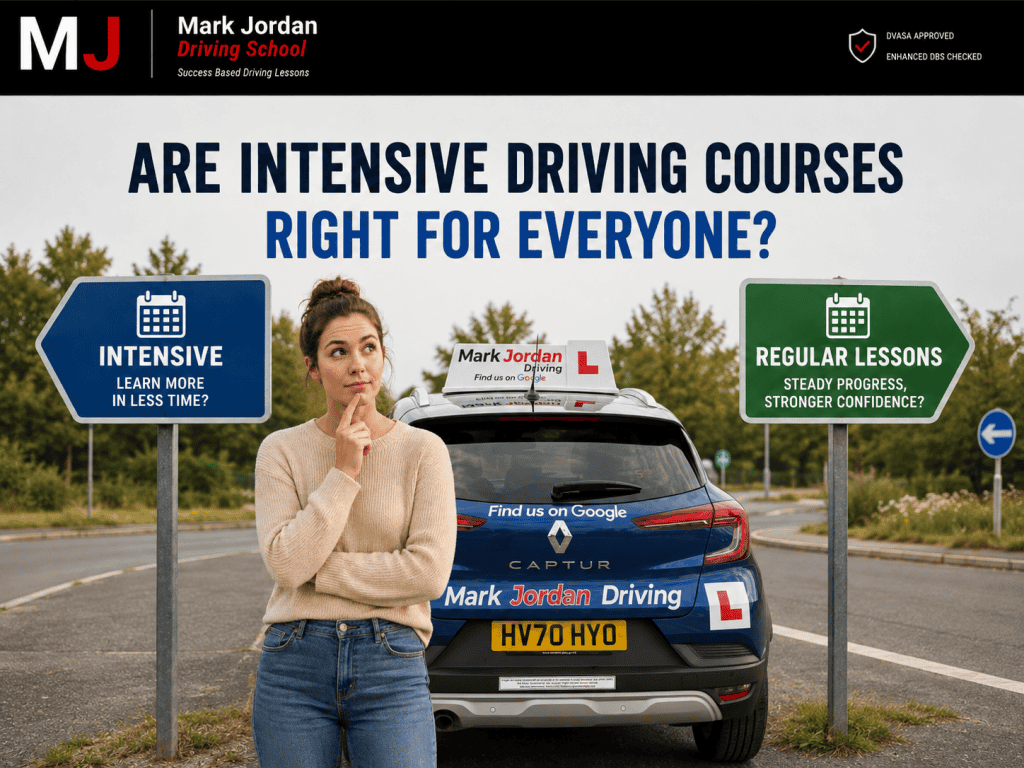
An intensive course usually involves completing a large amount of tuition over a short period.
Rather than having one regular lesson each week, a learner might drive for several hours a day over consecutive days or across one or two weeks.
There are genuine advantages to this.
Lessons are close together, so there is less time to forget what was covered previously. The learner gets plenty of repetition, and somebody who already has some driving experience may be able to build momentum quite quickly.
But this is where we need to be careful.
More hours in fewer days does not automatically mean more learning.
Two learners can complete exactly the same number of hours and make very different amounts of progress.
Learning to drive is personal.
Previous Experience Makes a Huge Difference
Imagine two learners both booking a 20-hour intensive course.
The first has already completed 30 or 40 hours of tuition, has had some private practice and can already drive independently on most roads. They may simply need to improve consistency, polish a few weaknesses and prepare properly for their test.
The second learner has never driven before.
They are starting from the very beginning.
They have to learn basic car control, moving off and stopping, steering, junctions, roundabouts, mirrors, observations, speed control, planning, manoeuvres, independent driving and much more.
These two learners may have bought the same course, but they clearly do not have the same training needs.
That is why fixed course lengths can sometimes be misleading.
A 10-hour course might be plenty for one experienced learner and nowhere near enough for somebody else.
A 30-hour course could take one learner beyond what they need while another might still require more time.
DVSA driver-training standards support an individual approach. Training should take account of a learner's previous experience, ability and changing needs rather than assuming everyone progresses at exactly the same rate.
So when somebody asks, “How many hours do I need?”, the most accurate answer is often:
It depends where you are starting from.
Who Can Benefit From Intensive Driving Lessons?
Intensive training can be a very good option for the right learner.
It may suit someone who:
- already has a reasonable amount of driving experience;
- has had a break from lessons and wants to get back up to standard;
- learns comfortably during longer sessions;
- can maintain concentration for several hours;
- is confident enough to cope with frequent new challenges;
- has a test booked and is genuinely close to test standard.
For these learners, concentrating lessons into a shorter period can provide useful continuity.
Skills learned yesterday can be revisited today rather than a week later.
For somebody already reasonably competent, that can be very effective.
But the important point is that the intensive format is helping an existing learner progress.
It is not magically creating driving ability simply because the lessons happen closer together.
Nervous Learners Need a Different Conversation
This is where I become much more cautious about recommending intensive driving courses automatically.
Nervous learners often need something slightly different.
They do not necessarily lack ability.
In fact, many nervous learners understand exactly what they are supposed to do.
The difficulty is often applying those skills confidently when the road gets busy or something unexpected happens.
A learner might understand how to approach a roundabout perfectly well during a discussion.
Then they arrive at a busy roundabout, see several vehicles approaching and suddenly feel overwhelmed.
That is not unusual.
Confidence develops through successful experiences.
Sometimes learners need time between lessons to think about what happened, process it and return ready to try again.
For one nervous learner, driving every day might help because there is less time for anxiety to build between lessons.
For another, three or four hours behind the wheel every day could become mentally exhausting.
Once concentration drops, the quality of learning can drop with it.
And that is the problem with treating intensive driving courses as a one-size-fits-all solution.
A nervous learner does not need to be rushed. They need to be challenged at the right pace.
Good driver training should stretch the learner without repeatedly pushing them beyond the point where they can learn effectively.
That is also why nervous learners should never feel that needing more time means they are poor drivers.
Some of the safest drivers take longer to learn because they want to understand things properly before moving on.
Completing the Course Does Not Mean You Are Test-Ready
This is probably the most important point of all.
If you buy a 30-hour intensive course and complete 30 hours of lessons, one thing is certain:
You have completed 30 hours of lessons.
What is not guaranteed is that you are ready for your test.
Driving-test readiness should be based on your driving, not the number of hours written on an invoice.
DVSA's Ready to Pass guidance focuses on whether learners can drive safely and independently without prompts from their instructor.
A genuinely test-ready learner should be able to manage normal driving situations without constantly being reminded what to do.
That means handling things such as:
- busy junctions;
- roundabouts;
- meeting traffic;
- changing speed limits;
- developing hazards;
- manoeuvres;
- unfamiliar roads;
- independent driving;
- unexpected actions from other road users.
They also need to demonstrate this consistently.
Driving brilliantly for 20 minutes and then needing repeated intervention for the next 20 is not test-ready.
Neither is driving safely only because the instructor is quietly helping with prompts.
The real question is:
Can you make safe decisions when nobody helps you?
That is much closer to what the practical driving test is assessing.
Why “Muscle Memory” Doesn't Tell the Whole Story
You sometimes hear the argument that intensive driving lessons produce better “muscle memory” because the learner repeats tasks again and again over a short period.
There is some common sense in the idea that repetition helps physical skills become more familiar.
Moving off, changing gear, steering and controlling the pedals certainly become easier with practice.
But driving is not only a physical skill.
You are constantly making decisions.
Is that gap safe?
Why has that vehicle slowed down?
Is the pedestrian about to cross?
Should I change lane?
Do I need to reduce my speed?
What is happening beyond the car directly in front of me?
Safe driving requires observation, anticipation, judgement and planning.
Those abilities are developed through experience as well as repetition.
So while intensive practice may help make the mechanical side of driving feel more natural, that alone does not guarantee somebody has developed the judgement required to drive safely and independently.
Why We Currently Prefer Regular Two-Hour Lessons
At Mark Jordan Driving School, we are not currently offering traditional intensive driving courses.
One important reason is the current driving-test situation.
With practical tests often needing to be planned well ahead, rushing somebody through a concentrated course can sometimes create another problem.
Imagine completing a highly intensive course and getting close to test standard, only to discover the practical test is still some time away.
The learner then needs to maintain that standard.
For many people, regular two-hour lessons currently make more sense.
A two-hour session gives enough time to work on a meaningful area of driving without trying to cram too much into one day.
There is also time between lessons for the learner to reflect on what went well, what needs improvement and what they want to work on next.
Where suitable private practice is available, that can add valuable experience between professional lessons.
Our Accelerated Learning System works on a similar principle.
The aim is not to rush through a predetermined number of hours.
It is to make each lesson productive, identify what is holding the learner back and move forward when they are ready.
Parents Should Look Beyond the Headline Number
Parents often contact driving schools wanting to know how many hours their son or daughter will need.
It is completely understandable.
Driving lessons are a significant expense, and everyone wants some idea of the overall cost.
But learning to drive does not work like buying a fixed number of classroom sessions.
You are developing a real-world skill where mistakes can have serious consequences.
A cheap or fast course is not necessarily good value if the learner finishes it lacking confidence and still needs additional lessons.
Likewise, a learner who takes longer has not necessarily wasted time or money.
If those extra lessons produce a safer, calmer and more independent driver, they have served a purpose.
The best measure of progress is not:
“How many lessons have you done?”
It is:
“What can you now do safely without help?”
That is the question parents should be asking too.
So, Are Intensive Driving Courses Worth It?
Yes — for some learners.
They can be an excellent option for someone who already has experience, learns well in longer sessions and is genuinely close to driving independently.
But they are not automatically the fastest route to passing.
They are not automatically better for beginners.
And they certainly are not automatically better for nervous learners.
Some learners thrive on concentrated training.
Others learn far better with regular lessons, time to reflect and gradual exposure to more difficult situations.
Neither approach is inherently right or wrong.
The mistake is assuming that everybody needs the same thing.
The Goal Isn't to Finish Quickly. It's to Be Ready.
Your driving test is important.
But it lasts for less than an hour.
If you pass, you could then spend the next 50 or 60 years driving without an instructor sitting beside you.
That is what your lessons should really be preparing you for.
So don't judge your progress purely by how quickly you can complete a course.
Don't assume somebody else's number of lessons should also be yours.
And don't feel pressured to take a test simply because the hours you originally booked have run out.
Instead, ask yourself:
Can I drive safely without prompts?
Can I deal with unfamiliar roads?
Can I make good decisions when something unexpected happens?
Can I manage my nerves well enough to think clearly?
Would I feel comfortable driving this road alone tomorrow?
When the answers are consistently yes, you are getting genuinely test-ready.
And that matters far more than being able to say you completed an intensive course in two weeks.
Frequently Asked Questions About Intensive Driving Courses
How many hours do I need for an intensive driving course?
There is no single number of hours that will suit every learner.
A learner who already has plenty of driving experience may only need a relatively short period of additional training, while a complete beginner may require considerably more.
The DVSA does not set a minimum number of lessons or practice hours before you can take your driving test. How long it takes depends on how quickly you develop the skills needed to drive safely and independently.
This is why choosing an intensive course purely because it offers a particular number of hours can be misleading. Your starting ability matters just as much as the number of hours you book.
Can a complete beginner take an intensive driving course?
Yes, a complete beginner can take intensive driving lessons, but that does not necessarily mean an intensive course will be the best way for them to learn.
A beginner has a lot to take in, from basic car control and observations through to junctions, roundabouts, planning, hazard awareness and independent decision-making.
Some people cope extremely well with concentrated training. Others benefit from having more time between lessons to practise, reflect and gradually build experience.
The important question is not whether a beginner can take an intensive course, but whether that particular learner is likely to learn effectively that way.
Are intensive driving courses good for nervous learners?
They can be, but they are certainly not right for every nervous learner.
Some anxious learners prefer driving frequently because shorter gaps between lessons help them maintain momentum and stop nerves building up again.
Others find several hours of driving each day mentally tiring. Once concentration drops or anxiety increases, adding more hours does not necessarily mean more useful learning.
For nervous learners in particular, the pace of training should be based on the individual. The aim should be to gradually build confidence and independence rather than simply complete the course as quickly as possible.
DVSA's Ready to Pass campaign also specifically provides guidance on managing driving-test nerves, reinforcing that being mentally prepared is part of preparing properly for the test.
Do intensive driving courses give you a better chance of passing?
You should be cautious about assuming that the format of your lessons alone determines whether you will pass.
What matters much more is the standard of driving you reach before taking the test.
DVSA guidance says learners should only take their test when they are properly prepared, and GOV.UK states that you should be able to meet the required driving standard without instruction.
An intensive course might help one learner reach that point quickly. Another learner may become better prepared through regular lessons and additional practice over a longer period.
Intensive training can shorten the time between lessons. It cannot guarantee how quickly an individual learner will become test-ready.
What happens if I finish an intensive course but I'm not ready for my test?
Finishing the course does not mean you have to take the test.
If you are still making significant mistakes, relying on prompts from your instructor or struggling to deal with certain situations independently, additional training may be the sensible option.
DVSA encourages learners to postpone their test if they are not properly prepared rather than taking it simply because an appointment has already been booked.
It can be disappointing to delay a test, particularly after completing a large block of lessons, but passing should never become more important than being able to drive safely.
Are weekly driving lessons better than an intensive course?
Neither approach is automatically better.
It depends on the learner.
Intensive tuition can suit someone who already has experience, learns well during longer sessions and benefits from very frequent practice.
Regular lessons can give other learners more opportunity to absorb what they have learned, build experience gradually and maintain their skills over a longer period.
At Mark Jordan Driving School, we currently favour regular two-hour lessons rather than traditional intensive courses, particularly while practical tests often need to be planned well in advance.
The important thing is that lessons continue to move you towards safe, confident and independent driving.
Whether that takes place over two weeks, two months or longer is far less important than the standard you reach at the end.
You can read our full informative guide Learning To Drive in Burton The Complete Guide For Learners And Parents