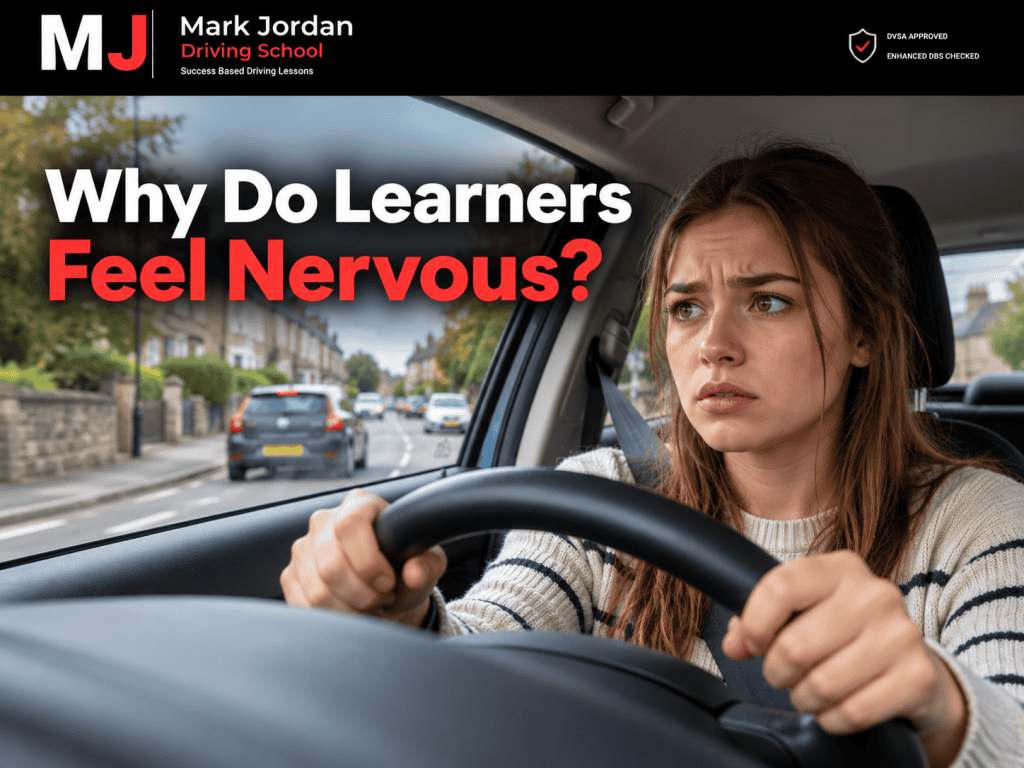
Learning to drive is not just about operating a car, remembering road signs or passing the practical test. A large part of the process is learning to trust your judgement.
For many learners, confidence develops slowly through practice, clear explanations and repeated experience. Even after passing the driving test, it is completely normal to feel nervous when driving without an instructor beside you for the first time.
As a professional driving instructor, I often explain that confidence does not mean feeling fearless. A confident driver still notices risks, thinks ahead and accepts that learning continues long after the driving test.
The aim is not to remove every nervous feeling. It is to know how to manage those feelings safely.
Confidence Starts With Understanding
People often lose confidence when they do not fully understand what is happening around them.
A busy roundabout can feel overwhelming when you are trying to watch several vehicles, choose a safe gap, control the car and remember where you need to go. However, once the situation is broken into smaller steps, it becomes easier to manage.
This is why driving lessons should be structured.
At Mark Jordan Driving School, we build skills gradually rather than expecting learners to cope with everything immediately. Complete beginners start in quieter areas where they can practise moving off, stopping and controlling the car without unnecessary pressure.
As their ability improves, we introduce junctions, roundabouts, busier roads and more independent driving.
A learner who understands why they are checking their mirrors, adjusting their speed or changing their road position will usually become more confident than somebody who has simply memorised an instruction.
Never be afraid to ask your instructor to explain something again. Asking questions is not a sign that you are failing. It is part of learning properly.
Stop Expecting Perfect Driving
One of the biggest causes of lost confidence is the belief that good drivers never make mistakes.
Experienced drivers sometimes choose the wrong lane, stall the car, miss a turning or need to correct a parking manoeuvre. The difference is that they usually remain calm and deal with the situation safely.
New drivers can treat every small mistake as proof that they are not good enough. This creates tension, and that tension can cause further mistakes.
Instead of criticising yourself, ask:
What happened?
Why did it happen?
What could I do differently next time?
This turns the mistake into useful feedback.
You will learn far more from understanding a mistake than from becoming frustrated by it. Confidence grows when you realise that an error can be corrected and does not automatically make you an unsafe driver.
Build Confidence Gradually
Confidence is easier to develop when practice has a clear purpose.
Rather than simply going for a drive and hoping everything goes well, choose one area to improve. This could include:
- Approaching roundabouts
- Meeting traffic on narrow roads
- Changing lanes
- Parking
- Driving independently
- Driving in the dark
- Using faster roads
The DVSA encourages learners to track their progress across the different skills needed for safe and independent driving. Mock tests can also help learners become familiar with test conditions and identify areas that need more practice.
The important word is gradual.
For example, somebody who feels nervous about roundabouts might begin with a quiet mini-roundabout. They could then progress to a larger roundabout outside peak traffic before attempting the same route during a busier period.
Jumping immediately into the most difficult situation can damage confidence. Building experience in manageable stages usually produces better and longer-lasting results.
Make Private Practice Productive
Private practice with a parent, family member or friend can be extremely useful when it supports what is being taught during professional lessons.
However, it works best when everybody is working in the same direction. Conflicting instructions can confuse the learner and make them question their ability.
Before practising, agree on the purpose of the journey and choose roads that are suitable for the learner’s current level.
Parents can help most by remaining calm, giving instructions early and recognising improvements. Constant criticism, grabbing the dashboard or comparing the learner with other people will usually make confidence worse.
After the drive, try asking:
“What felt better today?”
This encourages the learner to notice progress rather than focusing only on what went wrong.
Confidence After Passing the Test
Passing your test is a major achievement, but it does not mean you will immediately feel comfortable in every situation.
The first solo journey can feel strange because your instructor is no longer there. Your own car may also feel different from the one you learned in.
The clutch may respond differently, the mirrors may provide a different view and the controls may be in unfamiliar positions. Give yourself time to adjust.
Begin with familiar, shorter journeys at quieter times of the day. Once those feel comfortable, gradually introduce busier traffic, unfamiliar routes, night driving and faster roads.
There is no prize for attempting everything during your first week.
Safe progress matters more than fast progress.
Prepare Before You Drive
A few minutes of preparation can reduce a surprising amount of anxiety.
Before moving away, make sure your seat, mirrors and steering position are correct. Set your sat nav, check your route and decide where you could stop safely if you need a break.
Leave enough time for the journey so you do not feel rushed.
You should also put your phone somewhere you will not be tempted to pick it up. Using a handheld phone while driving is illegal and can result in six penalty points and a £200 fine.
For drivers within two years of passing their test, receiving six points can result in the licence being revoked. This means the theory and practical tests would need to be taken again.
Good preparation reduces the number of decisions you need to make while moving and allows you to concentrate on the road.
Do Not Let Other Drivers Rush You
Many new drivers worry about holding somebody up.
A vehicle following closely, an impatient driver or somebody sounding their horn can make you feel that you need to hurry.
You do not.
Your responsibility is to drive safely and legally. Do not enter a roundabout without a safe gap, exceed the speed limit or rush a manoeuvre because somebody behind you is impatient.
Confidence means making a safe decision even when another driver would prefer you to make a faster one.
Remain predictable, maintain an appropriate speed and concentrate on what is happening ahead.
Ask for More Support When Needed
You can take additional driving lessons after passing your test.
Some newly qualified drivers book lessons to practise motorways, parking, night driving or unfamiliar routes. Others return after taking a break from driving or following an experience that affected their confidence.
Official schemes such as Pass Plus can also help newly qualified drivers gain experience in different conditions.
Further training is not an admission of failure. It is a sensible way to develop skills with professional support.
Recognise Your Progress
Try not to judge your driving only by how nervous you felt before starting the journey.
Judge it by what actually happened.
Did you plan ahead?
Did you maintain a safe distance?
Did you respond calmly when something unexpected happened?
Did you complete a journey you would previously have avoided?
These are signs of genuine progress.
At Mark Jordan Driving School, we work with nervous learners and new drivers across Burton upon Trent, Swadlincote, Ashby-de-la-Zouch and Coalville. Our approach is calm, structured and based on building ability one manageable step at a time.
Whether you are preparing for your first lesson, approaching your driving test or beginning to drive independently, remember that confidence comes from evidence and experience.
Take the next manageable step, repeat it until it feels familiar, and then move forward again.
You do not need to feel completely fearless before you drive.
You need safe habits, a sensible plan and the willingness to continue learning.