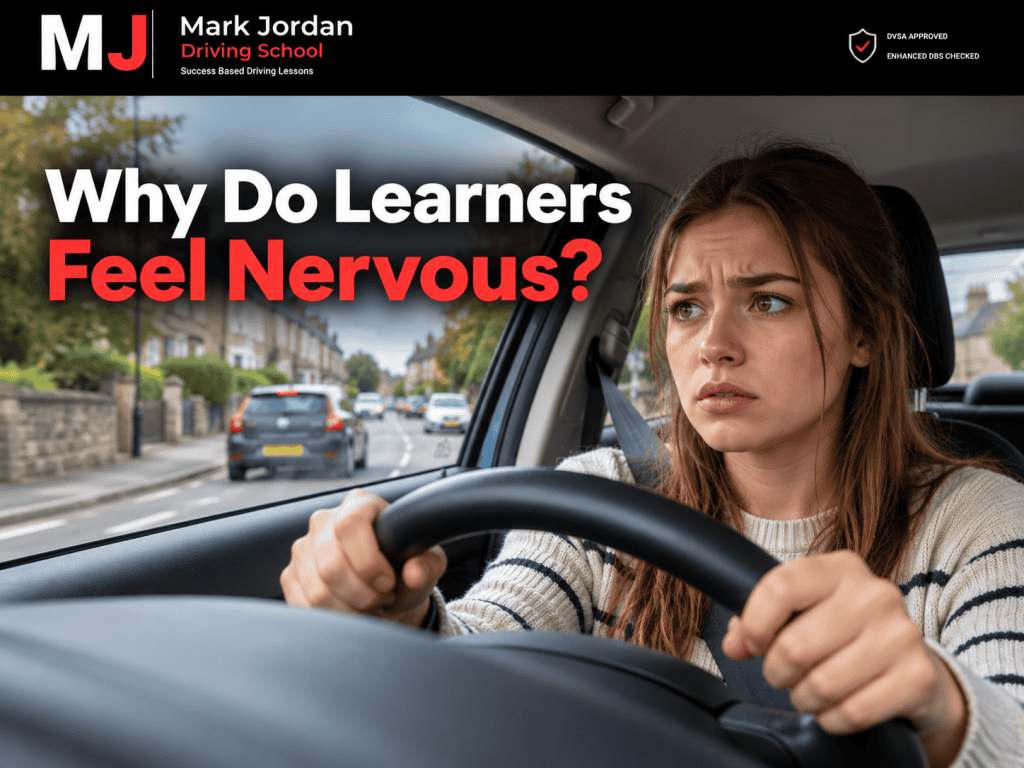
Your driving test is getting closer, and instead of feeling more confident, something strange seems to be happening.
You stall at a junction you have used dozens of times. Your approach to a roundabout feels rushed. You forget a mirror check, hesitate over a safe gap or make a decision that does not feel like you at all.
You leave the lesson wondering:
“Why is my driving getting worse when I should be at my best?”
The reassuring answer is that your driving ability has probably not disappeared. More often, test pressure has changed where your attention is going and how you react to ordinary mistakes.
The DVSA recognises that nerves can affect learners as they prepare for the practical driving test. Its official Ready to Pass guidance encourages learners to practise managing their nerves as part of becoming test-ready.
Your Driving Skills Have Not Suddenly Vanished
Learning to drive takes time. Your ability develops through explanation, repetition, practice and experience.
Those skills do not normally vanish just because a test date appears on the calendar.
What can change is your mindset.
During your earlier lessons, you were allowed to be a learner. You expected to ask questions, make mistakes and try again. As the test gets closer, you may begin treating every lesson as though it is the real test.
Instead of simply driving the road in front of you, part of your attention is now occupied by thoughts such as:
- What happens if I fail?
- Was that a serious fault?
- Does my instructor think I am ready?
- Will I disappoint my family?
- How long will I wait for another test?
Your brain is trying to drive while also judging, predicting and worrying. That leaves less attention available for observations, planning and decision-making.
You have not necessarily become a worse driver. You may simply be trying to think about too many things at once.
The Pressure to Be Perfect Can Make You Less Safe
One of the biggest mistakes learners make near test day is trying to produce a “perfect” drive.
They start checking mirrors in an exaggerated way, driving unnecessarily slowly or refusing safe opportunities because they are frightened of making the wrong decision.
For example, you may wait at a roundabout even though a safe gap is available. You are not waiting because the gap is unsafe. You are waiting because you are afraid that moving might lead to a mistake.
This is an important difference.
Driving too cautiously can be just as disruptive as rushing. It can confuse other road users, hold up traffic and stop you from demonstrating confident, independent decision-making.
The driving test is not a performance. You do not need special test-day driving techniques.
The examiner is looking for safe control, effective observations, sensible planning and appropriate decisions. Official DVSA guidance explains that driving faults are assessed according to their effect on safety and the circumstances in which they happen.
Drive as you have been taught. Do not try to turn every mirror check, gear change or junction into a performance for the examiner.

One Mistake Can Create Another
Imagine that you stall when moving away from a junction.
The stall itself may be dealt with safely within a few seconds. However, you then spend the next five minutes thinking about it:
“That would be a fault.”
“I have ruined the test.”
“I always do this under pressure.”
While replaying the stall, you miss a change in the speed limit or approach the next junction without enough planning.
The original mistake did not cause the bigger problem. Your reaction to it did.
A safe driver needs to be able to recover. That applies during lessons, on the driving test and after passing.
When something goes wrong, use this simple three-step reset:
Recognise it. Correct it safely. Return your attention to the road.
Do not attempt to mark your own test while you are still driving. You will not have all the information the examiner is using, and you may wrongly assume you have failed.
Taking a wrong direction is a good example. Following the route incorrectly is not automatically a driving fault. What matters is that you continue safely and respond properly to the road you are now on.
A Difficult Mock Test Does Not Always Mean You Are Not Ready
Some learners drive well during an ordinary lesson but struggle during a mock test.
The instructor becomes quieter, the learner receives less help and suddenly every decision feels more important.
That is partly what makes mock tests useful.
They allow you to experience being assessed without the result carrying the same consequences as the real test. They can reveal whether you rely on prompts, how you react to mistakes and whether pressure changes your decisions.
The DVSA recommends mock tests as a way of checking whether a learner can drive safely without help. Its guidance says learners are usually ready when they can drive independently, avoid serious or dangerous mistakes, pass mock tests and manage their nerves.
However, one poor mock test should not define your ability.
Look for patterns across several drives. If the same safety problem keeps happening, it needs attention. If you made a few unusual mistakes during one nervous lesson, your main focus may need to be pressure management rather than relearning the entire subject.
Are You Nervous, or Are You Not Ready Yet?
It is important to be honest here. Am I Ready For My Test?
Not every difficult lesson can be blamed on nerves.
You may need more practice if you regularly:
- require verbal prompts from your instructor;
- miss important observations;
- struggle to judge safe gaps;
- lose control when dealing with several hazards;
- repeat serious mistakes across different lessons;
- cannot complete an independent drive safely.
Being nervous is normal. Depending heavily on your instructor is a different issue.
A useful question is:
“Can I usually drive safely and independently, even when the drive is not perfect?”
Your instructor should help you answer that honestly. The official DVSA campaign recommends taking the test when your instructor agrees that you are ready to pass and drive independently.
Moving a test is disappointing, but taking it before you are ready can add more pressure and damage your confidence. A test date should be the result of being ready—not the reason you rush to become ready.
Stop Turning Every Final Lesson Into a Test

Your last few lessons should not be endless attempts to prove that you can pass.
Instead, each lesson should have a clear purpose.
You might work on:
- approaching busy roundabouts calmly;
- making safe decisions without prompts;
- noticing changes in speed limits;
- recovering after a mistake;
- following directions independently;
- dealing with unfamiliar roads;
- keeping a steady routine under pressure.
At the end of the lesson, avoid asking only, “Would I have passed?”
Better questions include:
- What went well consistently?
- Did I recognise developing risks?
- Did I make my own decisions?
- How quickly did I recover from mistakes?
- Is there a repeated issue that still needs work?
Passing is the eventual outcome. Safe and independent driving is the skill that produces it.
How to Prepare During the Final Week
Trying to cram in too much practice can leave you tired and frustrated.
Keep your preparation calm and purposeful. Review the areas that genuinely need attention, but do not keep testing yourself until your confidence collapses.
Maintain a normal sleep routine where possible, eat properly and avoid spending the night before the test watching endless driving-test videos or reading other people’s failure stories.
Practise a simple breathing exercise before lessons so that it feels familiar by test day. NHS guidance recommends calming breathing exercises as one way of managing feelings of stress and anxiety.
A straightforward routine is to breathe in gently, breathe out slowly and allow your shoulders and hands to relax. Do this while parked safely before the drive begins—not while trying to manage a difficult traffic situation.
The aim is not to remove every nerve. It is to stop nerves from taking control of your decisions.
What to Remember on Test Day
Do not begin the test thinking you must drive perfectly for the entire route.
Think only about the situation in front of you.
Before moving, settle into the car and complete your normal checks. Once you are driving, keep returning to the same basic process:
Look, plan, decide and act safely.
When you make a mistake, deal with what is happening now. Do not mentally return to the previous road.
You may feel nervous during the first few minutes and then gradually settle. You may feel calm at the start and tense later. Neither reaction tells you whether you are passing or failing.
Your job is not to predict the result.
Your job is to continue driving safely.
A Bad Lesson Does Not Erase Your Progress
A difficult lesson near test day can feel like proof that you are going backwards. Usually, it is only one piece of a much larger picture.
Think about what you can do now that once seemed impossible.
You can move away safely, deal with junctions, read the road, respond to other drivers and make decisions that you could not make when you first sat behind the wheel.
That progress still exists, even after a difficult drive.
As a driving instructor, I would rather see a learner make a mistake and recover calmly than drive well for forty minutes but fall apart the moment something goes wrong.
Safe driving is not about never making a mistake. It is about noticing problems, responding sensibly and remaining responsible for what happens next.
You do not have to prove that you are a perfect driver.
You need to show that you are a safe, observant and independent one.
Trust the work you have completed, follow the routines you have practised and take the test one road at a time.