“Should I learn in a manual or an automatic?”
It is one of the first questions many learner drivers ask, and there is no answer that suits everyone.
Automatic cars can remove some of the physical workload involved in driving, which may help certain learners feel calmer and more in control. However, passing in a manual gives you greater flexibility over the vehicles you can legally drive afterwards.
The right choice depends on your confidence, coordination, budget and the type of car you expect to drive once you have passed.
Here is an honest look at both options.
What Is the Main Difference?
In a manual car, you control the gears using the clutch pedal and gear lever. You need to learn how to move away smoothly, change gear, manage hills and prevent the car from stalling.
An automatic car changes gear for you. There is no clutch pedal, so the learner mainly controls the accelerator and brake.
That does not mean learning in an automatic is effortless. You must still develop safe observations, steering, positioning, judgement and planning. You will still need to deal with busy junctions, roundabouts, pedestrians and changing road conditions.
The practical driving test is the same whether it is taken in a manual or automatic car. The examiner is assessing whether you can drive safely and independently—not how many pedals your car has.
Who May Benefit From Automatic Tuition?
Automatic lessons can be helpful for learners who find that clutch control and gear changes take too much attention away from the road.
For example, you may understand how to approach a roundabout but struggle to put everything together while also braking, changing gear, controlling the clutch and deciding whether a gap is safe.
Removing the clutch and manual gear changes may give you more thinking time. You can concentrate more fully on:
- Observations and mirrors
- Steering and road position
- Choosing safe gaps
- Reading the road ahead
- Managing speed
- Responding to other road users
Automatic tuition may also suit someone who has already had manual lessons but finds that repeated stalling or difficulties with clutch control are damaging their confidence.
Changing to automatic is not failing or taking the easy option. It can be a sensible choice when it allows someone to learn more comfortably and safely.
However, an automatic car does not make difficult traffic situations disappear. Good judgement, awareness and forward planning remain essential.
Why Do Learners Still Choose Manual?
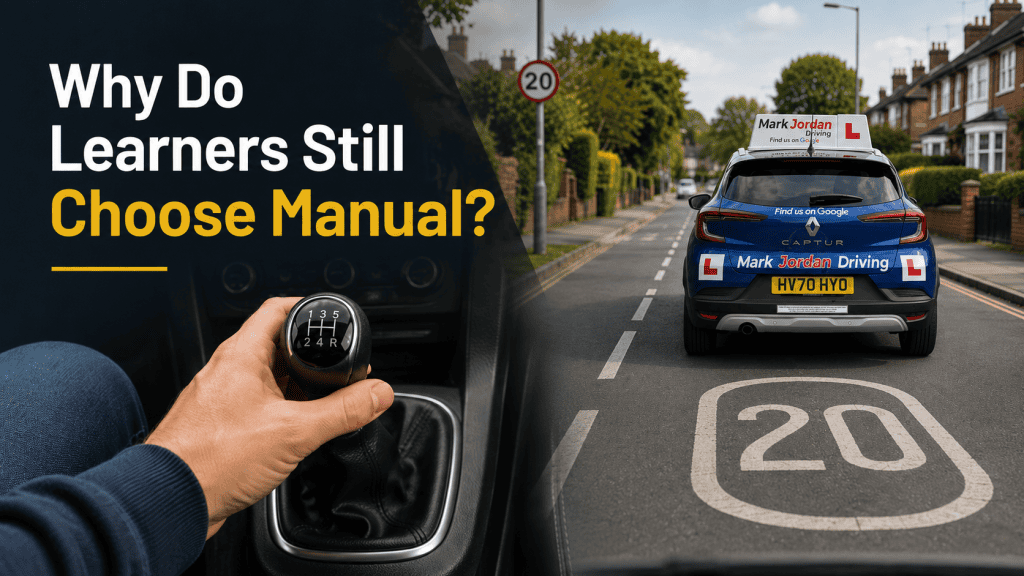
The biggest advantage of passing in a manual car is flexibility.
A manual licence allows you to drive both manual and automatic cars. This can be useful if you expect to share a family car, borrow someone else’s vehicle or need to drive different vehicles for work in the future.
Some learners also have access to a manual car for private practice. Being able to practise safely between professional lessons can help reinforce what they have learned, provided the accompanying driver, vehicle and insurance meet the legal requirements.
Manual lessons may be the better choice when:
- You expect your first car to be a manual
- You have access to a manual car for private practice
- You want the widest possible choice of vehicles
- You are comfortable taking time to develop clutch control
- You enjoy being more involved in controlling the car
Stalling or selecting the wrong gear during early lessons is normal. These mistakes do not mean you are unsuitable for manual driving. For most learners, the movements become more natural through calm and consistent practice.
What Licence Do You Get After Passing in an Automatic?
This is the part every learner should understand before making a decision.
When you pass your practical test in an automatic car, your licence is restricted to automatic vehicles. This is shown by code 78 on the back of the driving licence. You cannot legally drive a manual car with an automatic-only licence.
You can upgrade later, but you will need to take and pass another practical driving test in a manual car.
You do not need to apply for another provisional licence, and you do not normally need to take another theory test when upgrading from an automatic car licence to a manual one.
Think beyond the driving test. Ask yourself what you are realistically likely to drive during the first few years after passing.
Is Automatic Better for Nervous Learners?
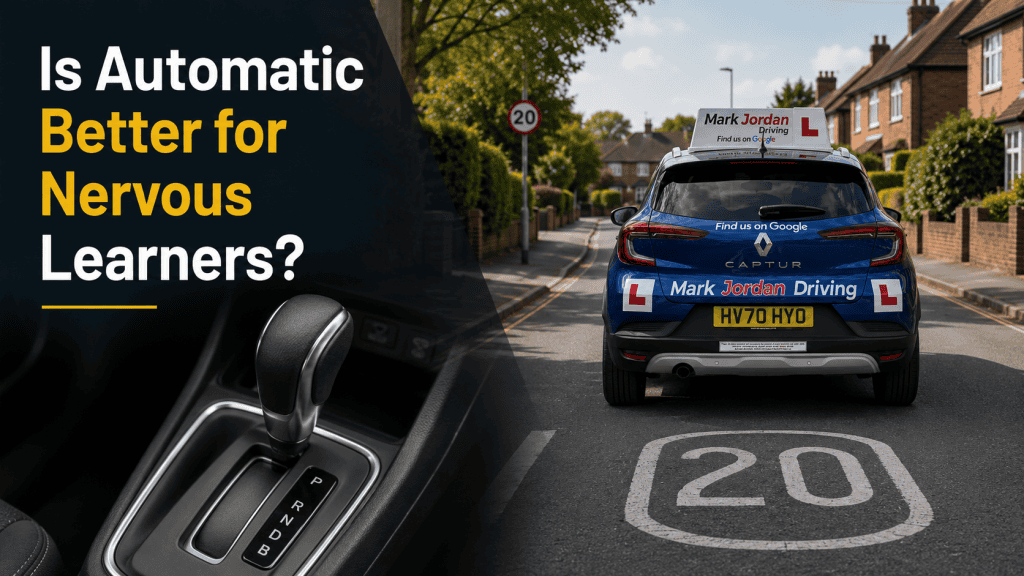
It can be, but nervousness alone does not mean you should automatically choose an automatic car.
Some learners feel noticeably calmer when they no longer have to worry about stalling, clutch control or changing gear at the right moment. Reducing that workload can make busy situations feel less overwhelming.
Other nervous learners do perfectly well in a manual when they are taught at the right pace.
The instructor’s approach is often just as important as the vehicle. A nervous learner needs clear explanations, manageable steps and enough time to repeat a skill without feeling judged or rushed.
A good lesson should gradually build your confidence. You should not be pushed into a busy Burton roundabout simply because you have completed a certain number of hours.
When deciding between manual and automatic, consider what is actually causing your anxiety. When the gears and clutch are the main problem, automatic may help. When the nerves come from traffic, judgement or fear of making mistakes, changing transmission may not solve the underlying concern.
Will Automatic Lessons Save You Money?
Possibly—but it should never be promised.
At Mark Jordan Driving School, a two-hour pay-as-you-go lesson is currently £74 for manual and £78 for automatic. A ten-hour package is £350 for manual and £370 for automatic.
An automatic lesson therefore costs slightly more, but some learners may find that they make progress more comfortably without the clutch and gears. Others may need a similar number of hours whichever vehicle they choose.
Your total cost will depend on factors such as:
- Previous driving experience
- Confidence and anxiety
- Lesson frequency
- Private practice
- How quickly skills become consistent
- Your ability to drive safely in different conditions
There is no official minimum number of lessons that a learner must complete before taking a practical test. Everyone learns at a different rate.
Be cautious of anyone promising that automatic lessons guarantee a quick or cheap pass. Passing the test depends on becoming a safe and independent driver, not simply removing the clutch pedal.
Availability in Burton, Swadlincote, Ashby and Coalville
Mark Jordan Driving School offers manual and automatic driving lessons across Burton upon Trent, Swadlincote, Ashby-de-la-Zouch and Coalville.
However, availability can vary between areas. It depends on where each instructor is based, whether they teach manual or automatic, and the spaces currently available in their diary.
Automatic availability may sometimes be more limited. It is worth checking before making plans around a particular day, time or test date.
When making an enquiry, include your location, previous driving experience, preferred transmission and the days you are available. This makes it easier to give you an honest answer about the most suitable options.
Manual or Automatic: How Do You Decide?
Manual may be right for you when you want the freedom to drive either type of car and you are prepared to spend time learning clutch and gear control.
Automatic may be right for you when the physical coordination of a manual is creating a barrier to your progress or preventing you from concentrating fully on the road.
Do not choose automatic because someone has promised it will guarantee a faster pass. Equally, do not choose manual simply because friends or family tell you that learning in an automatic is somehow less worthwhile.
Choose the car in which you are most likely to become a confident, observant and safe driver.
To ask about manual or automatic driving lessons in Burton, Swadlincote, Ashby or Coalville, contact Mark Jordan Driving School through our website. Tell us a little about your experience, confidence and availability, and we will help you consider the most suitable option.
You can read our full informative guide Learning To Drive in Burton The Complete Guide For Learners And Parents