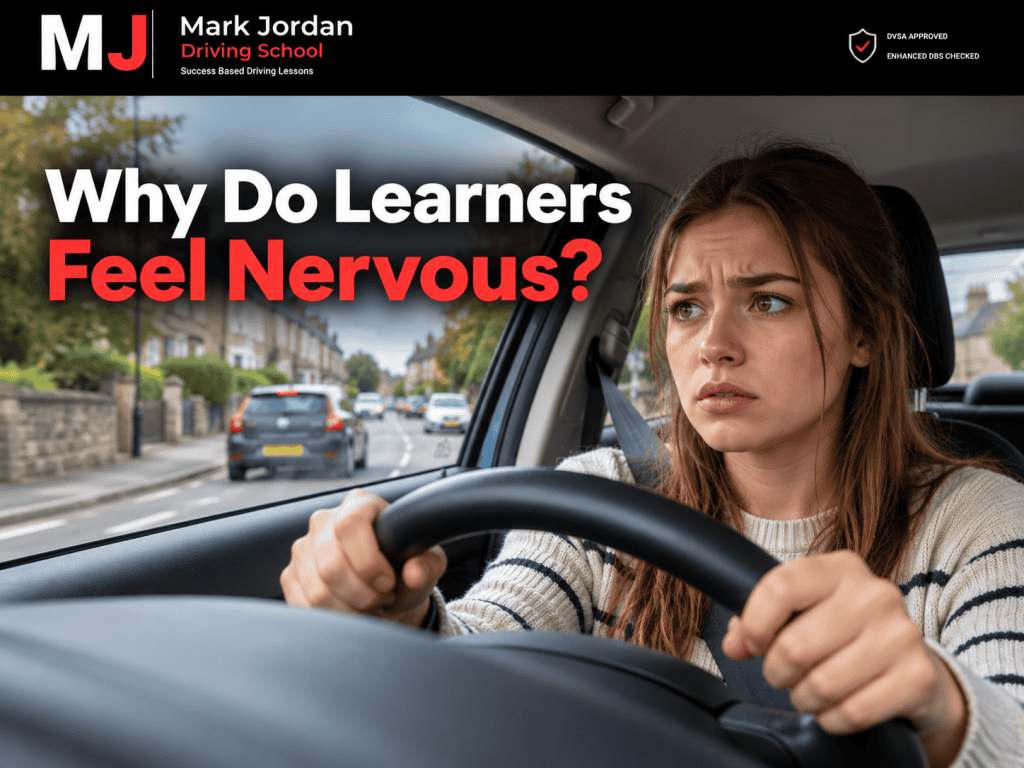
If you feel nervous before a driving lesson, you are certainly not alone.
In fact, nerves are one of the most common things driving instructors deal with.
Some learners feel anxious before they have even sat behind the wheel. Others start confidently but become nervous when lessons move onto roundabouts, faster roads, busy junctions or independent driving. For some, the nerves only really appear when the driving test starts to feel close.
None of that automatically means you are bad at driving.
Learning to drive asks your brain to process a huge amount of new information while also controlling a moving vehicle. You are making decisions, watching other road users, following road signs and markings, judging speed and distance and, at the same time, trying to remember everything your instructor has taught you.
That is a lot to take in.
The aim is not necessarily to remove every nervous feeling. It is to learn how to manage those feelings so they do not take control of your driving.
Why Does Learning to Drive Feel So Overwhelming?
Think about how different driving feels to a complete beginner compared with an experienced driver.
An experienced driver can usually move away, change gear, steer, check mirrors and judge traffic without consciously thinking about every individual action.
A learner cannot do that yet.
In the early stages, almost everything requires concentration.
You might be thinking:
"Have I checked my mirrors?"
"Is this the right gear?"
"Am I too close to the kerb?"
"Who has priority?"
"Can I go?"
"What is that car behind me doing?"
That mental workload is one of the reasons driving can initially feel exhausting.
For somebody who hasn't started yet, simply understanding what happens on your first driving lesson can remove some of the uncertainty before getting behind the wheel.
As your experience increases, many of these actions gradually become more familiar. That frees up more of your attention to concentrate on what is happening further ahead.
This is one of the reasons confidence often develops slowly rather than appearing overnight.
The Fear of Getting Something Wrong
Many nervous learners are not actually frightened of driving itself.
They are frightened of making a mistake.
That might mean stalling at a junction, choosing the wrong gear, missing an opportunity at a roundabout or needing their instructor to help them.
Sometimes pupils expect themselves to drive perfectly because they understand what they are supposed to do.
But understanding something and being able to perform it consistently are two different things.
You can understand exactly how a roundabout works and still find it difficult to judge a gap while also controlling the car, checking mirrors, signalling, steering and watching other traffic.
That is why practice matters.
Mistakes are not proof that you cannot drive. Used properly, they are information.
A useful question is not:
"Why did I get that wrong?"
It is:
"What can I do differently next time?"
That small change in thinking can make a big difference.
One Mistake Can Easily Become Five
This is something we see regularly.
A learner stalls.
They become annoyed with themselves.
They start thinking about the stall instead of the road ahead.
Because their concentration has dropped, they miss a mirror check.
Then they rush the next junction.
Suddenly, one small mistake has affected several minutes of driving.
Learning to mentally reset is therefore a very useful skill.
Once something has gone wrong, deal with it safely, learn from it and then bring your attention back to what is happening now.
You cannot change the junction you drove through two minutes ago.
You can influence the next one.
"I'm Holding Everyone Up"
This is another huge source of unnecessary pressure.
You stop at a junction and see a car waiting behind you.
Immediately your mind starts racing.
"They're getting annoyed."
"I need to go."
"I'm taking too long."
The danger is that you stop making your own decision and start driving for the person behind you.
That is when people rush.
The driver behind may have been driving for decades. You may have had only a few hours of experience.
You are not supposed to be equally quick.
A safe decision is more important than a fast decision.
If another driver has to wait a few extra seconds while you make sure it is safe to move, let them wait.
Their impatience should never make your decision for you.
Comparing Yourself With Other Learners
"My friend passed after hardly any lessons."
"My brother passed when he was 17."
"Someone at college has already passed."
Comparisons like these are rarely helpful.
Two people can start driving lessons on the same day and progress at completely different rates.
One may have private practice several times a week. The other may only drive during lessons.
One may live near quiet roads. Another may learn in much busier traffic.
One may naturally feel confident behind the wheel. Another might need more time before things begin to feel comfortable.
The number of lessons somebody else needed tells you very little about how many you will need.
The target should not be to learn faster than somebody else.
The target should be to become a safe, confident and independent driver.
This is also why understanding what you should actually expect from a good driving lesson matters more than comparing the number of lessons you have had with somebody else.
Parents Can Accidentally Add Pressure Too
Parents usually want to help, but sometimes encouragement can unintentionally turn into pressure.
Comments such as:
"I don't remember needing this many lessons."
"I passed after 20 hours."
"You've done this before."
may sound harmless, but to a nervous learner they can feel like criticism.
Driving has also changed considerably over time.
Roads are busier, vehicles are different and today's learners are expected to demonstrate safe, independent decision-making across a wide range of situations.
What helps most is encouragement based on progress.
Instead of asking:
"How many more lessons do you need?"
try asking:
"What did you work on today?"
That changes the conversation from speed to learning.
Parents who are also helping with private practice may find our guide to driving habits parents should avoid passing on to learners useful.
Why Do Nerves Sometimes Get Worse Later?
It can be confusing when somebody starts lessons confidently and then becomes nervous several weeks later.
Usually there is a simple reason.
The driving has become harder.
Early lessons may take place on quieter roads and focus on basic control.
Later, the learner may start dealing with busy roundabouts, dual carriageways, meeting traffic, unfamiliar routes and making more decisions without help.
The level of challenge has increased.
That does not necessarily mean confidence has gone backwards.
Quite often, the learner has simply moved onto the next stage of learning.
Break Difficult Driving Into Smaller Pieces
One of the best ways to deal with something that feels overwhelming is to stop treating it as one enormous problem.
Take roundabouts.
A nervous learner might say:
"I'm terrible at roundabouts."
But "roundabouts" involves several separate skills.
You need to:
- recognise the roundabout early
- check mirrors
- reduce your speed
- choose the correct position
- identify traffic that may affect you
- decide whether there is a safe opportunity to go
- steer accurately
- use the correct lane
- identify your exit
- check mirrors and signal when appropriate
When you break the task down, it becomes much easier to identify where the actual difficulty lies.
Perhaps the problem is not roundabouts at all.
Perhaps the learner approaches too quickly and therefore does not have enough time to assess the traffic.
Solve that one problem and suddenly the entire roundabout can feel easier.
Tell Your Instructor When You Are Nervous
Never feel that you need to hide nerves from your driving instructor.
We need to know.
If a particular road, junction or situation is worrying you, say so.
A good driving lesson should be adaptable.
Sometimes the answer is to practise the situation again.
Sometimes it is better to step back and practise one part of the skill first.
Sometimes the pupil simply needs a clearer explanation of what they should be looking for.
DVSA's Ready to Pass? guidance also recognises that managing nerves is an important part of becoming ready to drive independently.
Nerves should be discussed, not ignored.
Give Yourself More Time
Nervous drivers often rush.
That sounds strange because anxiety can make somebody feel hesitant, but the actual driving often becomes hurried.
They brake late.
They approach junctions too quickly.
They feel pressured to make an immediate decision.
Creating more time can reduce that pressure dramatically.
Look further ahead.
Recognise developing situations earlier.
Reduce your speed in good time.
Prepare the car before you reach the junction.
The more time you give yourself, the more time your brain has to understand what is happening.
Planning ahead is not just good driving.
For nervous learners, it can also make the entire experience feel calmer.
Try Not to Aim for Perfection
Perfection is a terrible target for a learner driver.
Even experienced drivers make mistakes.
The aim of lessons is to gradually reduce those mistakes, understand why they happened and become capable of dealing with different situations safely.
You are learning a practical skill.
There will be good lessons and difficult lessons.
There may even be lessons where you feel as if you have gone backwards.
That does not mean the learning has disappeared.
Progress is rarely a perfectly straight line.
Use Simple Techniques Before the Lesson
If you usually feel nervous before the lesson even starts, it may help to arrive without rushing.
Give yourself a few minutes.
Avoid turning up at the last second after running from work, school or college.
Slow, controlled breathing can also help some people feel calmer.
The NHS recommends simple breathing exercises for stress and anxiety, such as breathing gently and regularly and allowing the breath to flow comfortably.
You do not need an elaborate routine.
The purpose is simply to arrive at the beginning of the lesson feeling as settled as possible.
Focus on Evidence of Progress
Nervous learners can become very good at remembering mistakes and very bad at remembering improvements.
You might finish a lesson remembering the one junction where you needed help.
But what about the other ten junctions you completed correctly?
Perhaps you drove a busy road that frightened you three weeks ago.
Perhaps you dealt with a roundabout without being prompted.
Perhaps your instructor spoke much less because you were making more of the decisions yourself.
Those things matter.
A useful habit is to finish every lesson by identifying three things:
What went well?
What improved?
What needs more practice?
This keeps the focus on development rather than simply judging the lesson as "good" or "bad".
Parents Helping With Private Practice
Private practice can be extremely useful, but it needs to remain calm.
If you are supervising your son or daughter, remember that they are still processing information much more slowly than an experienced driver.
Try not to give five instructions at once.
Give important information early.
Avoid shouting unless there is an immediate safety reason.
And if something goes wrong, allow the learner time to recover.
One of the quickest ways to make somebody nervous is to make them frightened of making a mistake.
Ideally, private practice should support what is being taught professionally rather than creating a completely different system.
If you are unsure why your son or daughter has been taught something in a particular way, ask them or speak to their instructor.
What About Driving Test Nerves?
Feeling nervous about the driving test is normal.
DVSA's Ready to Pass? campaign specifically discusses driving test nerves and encourages learners to practise ways of managing them before test day.
The important thing is not to suddenly start trying to "fix" your nerves the night before your test.
Managing pressure should be practised during normal lessons.
Drive unfamiliar routes.
Practise independent driving.
Complete mock-test style sessions.
Learn how to recover after a mistake without allowing it to ruin the rest of the drive.
These skills are useful whether you are sitting a driving test or driving alone after passing.
Passing Your Test Does Not Magically Remove Nerves
This is something learners do not always consider.
Your first solo drive can feel strange.
So can your first motorway journey.
Your first drive into a large city.
Your first journey at night.
Your first unfamiliar multi-lane roundabout.
Passing your test means you have demonstrated the required standard to drive independently. It does not mean you will instantly feel confident in every driving situation imaginable.
Confidence continues to develop after passing.
That is completely normal.
When Driving Anxiety Is Affecting More Than Driving
There is an important distinction between normal nervousness about learning a new skill and anxiety that is persistent or affecting everyday life.
If anxiety feels difficult to control, regularly causes significant distress or affects areas of life beyond driving lessons, it may be sensible to speak with a GP or another suitably qualified healthcare professional.
Driving instructors are trained to teach people to drive.
We can adapt lessons, build skills gradually and help pupils become more confident behind the wheel, but we are not mental health professionals.
Knowing when additional support might be useful is important.
You Do Not Need to Be Fearless to Become a Good Driver
Perhaps this is the most important thing to remember.
Confidence does not mean believing that nothing will ever go wrong.
Good drivers recognise risk.
They think.
They plan.
They give themselves time.
And when something unexpected happens, they deal with it.
That is what learner drivers are gradually developing.
At first, everything feels new.
Then certain roads become familiar.
Junctions become easier.
You begin recognising situations earlier.
Your instructor needs to say less.
Eventually, you realise that something which once made you nervous has become something you simply deal with.
That is real driving confidence.
Nervous About Starting Driving Lessons?
At Mark Jordan Driving School, we teach learners across Burton upon Trent, Swadlincote, Ashby-de-la-Zouch and Coalville, and nervous pupils are certainly nothing unusual.
Some pupils arrive worried about making mistakes.
Some worry about traffic.
Some have had a previous experience that knocked their confidence.
Others cannot even explain why they feel nervous — they simply do.
That is okay.
The important thing is to work at a pace where you are being challenged enough to improve without constantly feeling overwhelmed.
Driving lessons should gradually move you towards making safe decisions independently.
So if you are nervous before your next lesson, do not judge yourself for it.
Tell your instructor.
Take the pressure off being perfect.
Focus on the next decision rather than the last mistake.
And remember that confidence usually does not arrive before experience.
Confidence is built because of experience.
One junction, one roundabout and one successful drive at a time.